Geographic Location and Regional Setting
Double Island Point is located at approximately 25°55′S, 153°11′E, within the Cooloola Recreation Area - the northern section of Great Sandy National Park on Queensland's Sunshine Coast.
The site forms the northern anchor of a continuous beach system (Teewah Beach) that runs south toward Noosa North Shore. Teewah Beach, the linear sandy coast set behind the Inskip Peninsula, fronts the Coral Sea and lies immediately west of the world's largest sand island, K'gari (Fraser Island).
Administratively, Cooloola is a Recreation Area within Great Sandy National Park, extending from the Noosa North Shore to Rainbow Beach and protecting land down to the low-water mark. The area spans approximately 61,750 hectares and includes national park and other tenure categories that together form a green coastal belt of globally significant coastal dunes, freshwater lakes, and estuarine-marine interfaces.
The region's cultural landscape is Kabi Kabi Country. In June 2024, the Kabi Kabi people were formally recognised as native title holders over a substantial area of the Sunshine Coast, including parts of the Cooloola coast, with non-exclusive rights that include access, movement, and the right to take resources for any purpose, subject to applicable laws.
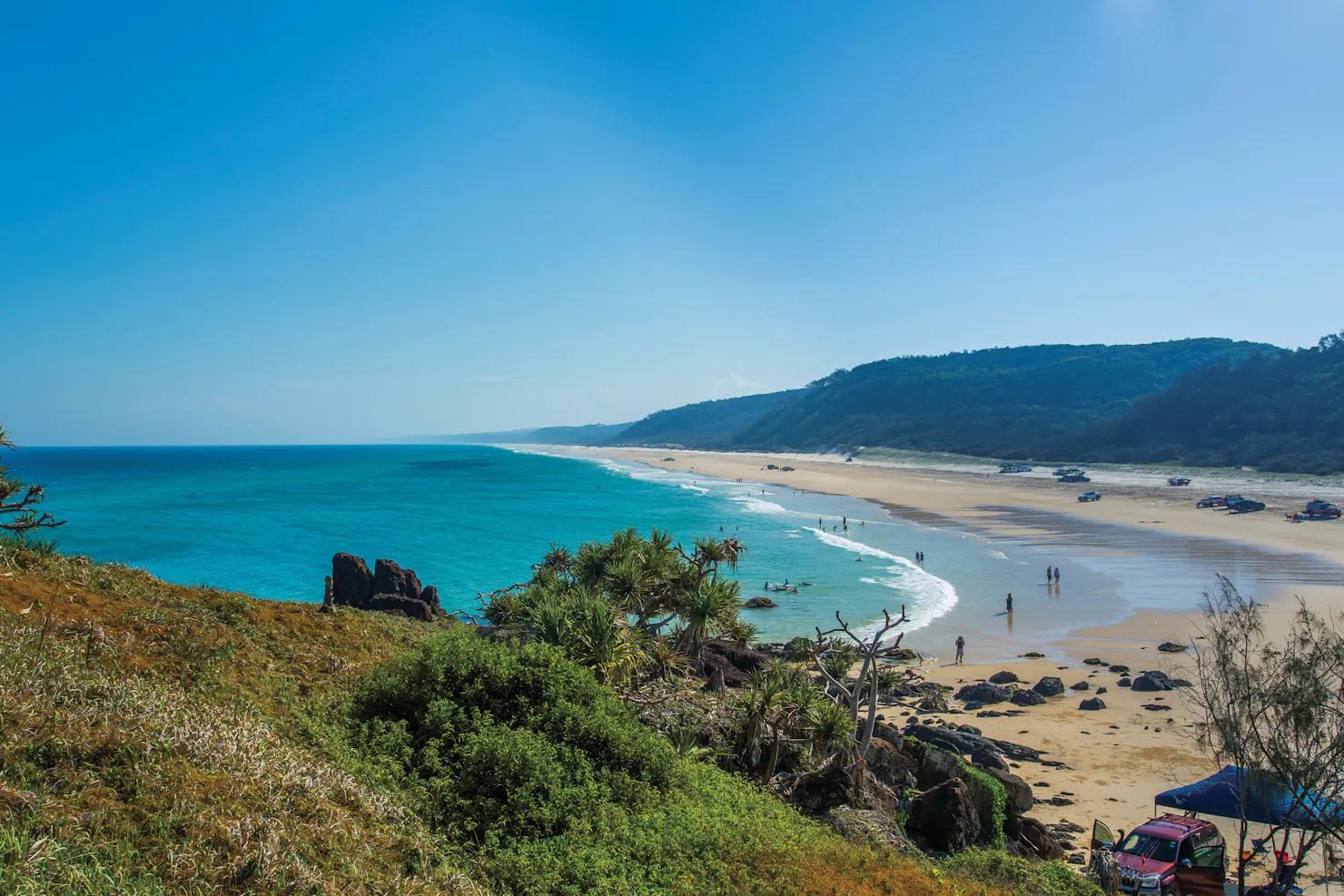
Double Island Point coastal landscape with characteristic sandblow formation and volcanic headland

Shell midden archaeological site in coastal dune environment showing natural erosion exposure
Site Characteristics and Formation
The Double Island Point burial site is located on a sandblow formation with associated shell midden and stone artefact scatter. This dynamic coastal environment creates unique conditions for archaeological preservation and exposure.
Environmental Setting
The site occurs within an active coastal dune system where wind erosion periodically exposes underlying archaeological materials. The sandblow location provides natural visibility of subsurface deposits while also presenting preservation challenges.
Vegetation and Landscape
The surrounding vegetation includes characteristic coastal species such as spinifex grass, casuarina, and banksia. These plants form part of the broader coastal ecosystem that has supported Aboriginal occupation and resource utilization for thousands of years.
Archaeological Context
The site contains evidence of Aboriginal occupation spanning the Holocene period, with archaeological materials including stone tools, shell middens, and burial contexts. The combination of burial features with domestic and subsistence remains provides insights into traditional Aboriginal lifeways in this coastal environment.
Coastal Dune Systems and Geomorphology
The Cooloola coastal environment is characterized by one of the world's longest and most complete dune chronosequences, recording environmental changes over tens of thousands of years.
Six-System Dune Chronosequence
Cooloola's landscape is built upon a six-system dune chronosequence that reflects major environmental shifts during the Holocene and Pleistocene periods:
- Holocene Systems (1-3): Nearshore active and semi-active dunes formed during the current interglacial period
- Pleistocene Systems (4-6): Inland dune formations representing earlier sea-level positions and climate conditions
Active Sandblow Dynamics
Active sandblows cycle through processes of burial and re-exposure, generating the formation pathways for sandblow archaeological sites. This dynamic process:
- Buries archaeological surfaces under advancing dune systems
- Subsequently re-exposes older surfaces through deflation processes
- Produces lag gravels and artefacts with variable preservation states
- Creates unique archaeological visibility and conservation challenges
Archaeological Implications
The dune system's dynamic nature directly controls archaeological visibility and preservation. Sites may be buried for centuries before erosion exposes them again, while exposed materials face increased weathering and damage. This process explains both the discovery of the Double Island Point burials (through natural erosion) and the importance of systematic documentation and protection measures.
Archaeological Significance and Research Background
The Double Island Point site represents a crucial component in understanding Aboriginal settlement patterns and subsistence strategies throughout the Holocene period in coastal southeast Queensland.
Regional Archaeological Framework
Systematic surveys across Cooloola have recorded over 100 archaeological sites across coastal, estuarine, and sandblow contexts. These sites demonstrate:
- Early Phase occupation (c. 5500-2300 cal BP) focused on plant processing and mixed marine-rainforest resources
- Recent Phase developments (last ~900-100 years) dominated by shell midden formation
- Long-term adaptation to dynamic coastal environments
- Sophisticated resource procurement and processing strategies
Sandblow Archaeological Context
The Double Island Point site occurs within a well-documented category of sandblow artefact sites that include King's Bore, White Cliffs, Cooloola Sand Patch, and Fern Gully. These sites share characteristics of:
- Burial and subsequent re-exposure through natural dune processes
- Stone artefact assemblages with variable preservation
- Association with plant processing activities
- Evidence for extended temporal occupation
Research Significance
The burial discoveries at Double Island Point add a crucial mortuary dimension to the region's archaeological record. While the area's settlement and subsistence patterns were relatively well understood, evidence for traditional burial practices was previously absent, making these discoveries particularly significant for understanding:
- Social organization and group identity development
- Traditional mortuary practices and their environmental context
- The relationship between domestic spaces and burial locations
- Cultural continuity and change through time